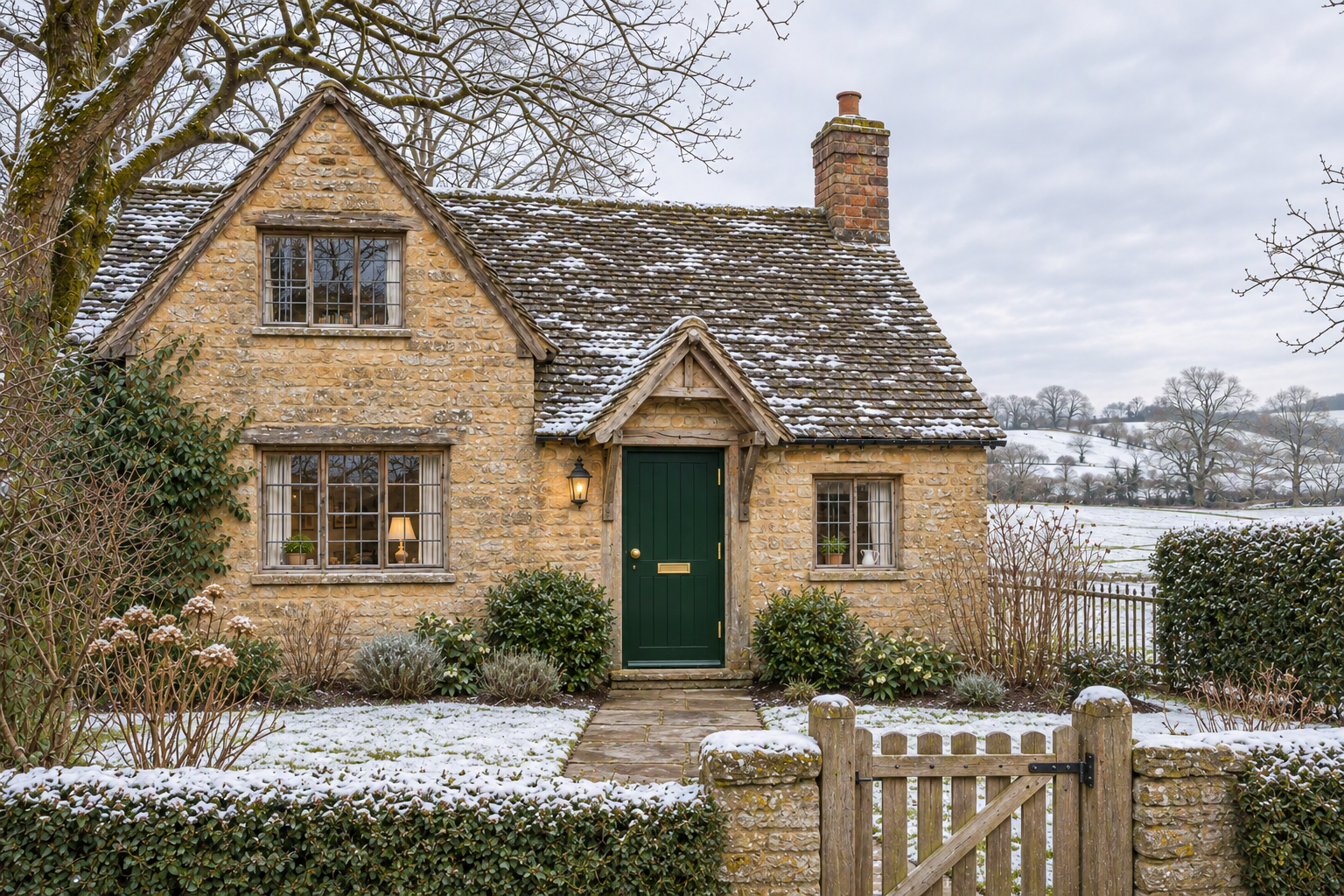
A new approach to short-term serviced accommodation during the winter months on the Isle of Wight
Information and guidance for second-home owners
Many owners of second homes on the Isle of Wight have traditionally made their properties available for occupation during the quieter winter months. This has provided an opportunity to generate additional income, contribute towards the running costs of the property and make productive use of an otherwise vacant home.
However, significant changes introduced by the Renters’ Rights Act 2025 have changed the legal landscape for residential letting in England.
At BCM Wilson Hill, we have developed a structured approach to short-term winter accommodation, using a professionally prepared Licence to Occupy agreement, supported by an appropriate programme of property servicing and management.
This guide explains the changes, the implications for property owners and how our proposed arrangement works.
What has changed under the Renters’ Rights Act?
The Renters’ Rights Act 2025 came into force in England on 1 May 2026, bringing substantial changes to the private rented sector.
Previously, landlords could grant an assured shorthold tenancy (AST) and, in certain circumstances, rely on Ground 3 of Schedule 2 to the Housing Act 1988 to recover possession following a seasonal holiday letting arrangement.
Ground 3 was particularly relevant to properties that were used as holiday accommodation during the summer and subsequently let to residential occupiers during the winter.
It provided a specific statutory ground for possession where the property had been used as holiday accommodation during the 12 months before the tenancy commenced, subject to the statutory requirements.
Ground 3 has now been repealed.
Consequently, owners can no longer rely on the previous Ground 3 provision to recover possession of a property simply because it was intended to return to holiday accommodation following a winter tenancy.
There have also been wider changes:
- Assured shorthold tenancies have been abolished.
- New assured tenancies are now periodic rather than fixed-term arrangements.
- The previous Section 21 no-fault possession procedure has been abolished.
- Landlords must rely on the revised statutory possession grounds where an assured tenancy applies.
This means that an owner granting what they believe to be a straightforward tenancy for the winter months will find that without the option of being able to rely a legally prescribed reason to seek possession of the property, the tenancy that was intended to create a contact between the parties will not provide a genuine reason for the owner seeking possession and therefore, the tenancy arrangement presents significant difficulties when seeking to recover possession at the intended end of the winter period.
With the abolition of fixed term tenancies, a tenancy can no longer be granted for a fixed term and any attempt to create a fixed term tenancy arrangement will not be legally binding and will be in breach of the Renters’ Rights Act 2025, thus exposing the property owner to significant financial penalty.
Why consider a Licence to Occupy?
A genuine licence to occupy is legally different from a tenancy.
A tenancy generally grants an occupier exclusive possession of a property for a period of time, whereas a genuine licence permits occupation on agreed terms without granting exclusive possession.
The distinction is important because a genuine licence to occupy does not become an assured tenancy simply because someone occupies residential accommodation.
However, the legal status depends on the actual arrangements and the way the property is operated, not simply the title of the agreement.
Our approach is to provide short-term serviced winter accommodation under a Licence to Occupy agreement, with the property owner retaining meaningful rights of access and providing ongoing services throughout the occupation.
The intention is to establish a genuine, serviced accommodation arrangement rather than an ordinary residential letting dressed up as a licence.
How does the arrangement work?
Under the BCM Wilson Hill approach, the property is made available as short-term serviced accommodation for a defined winter period.
The occupier enters into a Licence to Occupy agreement rather than an assured tenancy agreement. The arrangement is supported by an agreed programme of services and property management.
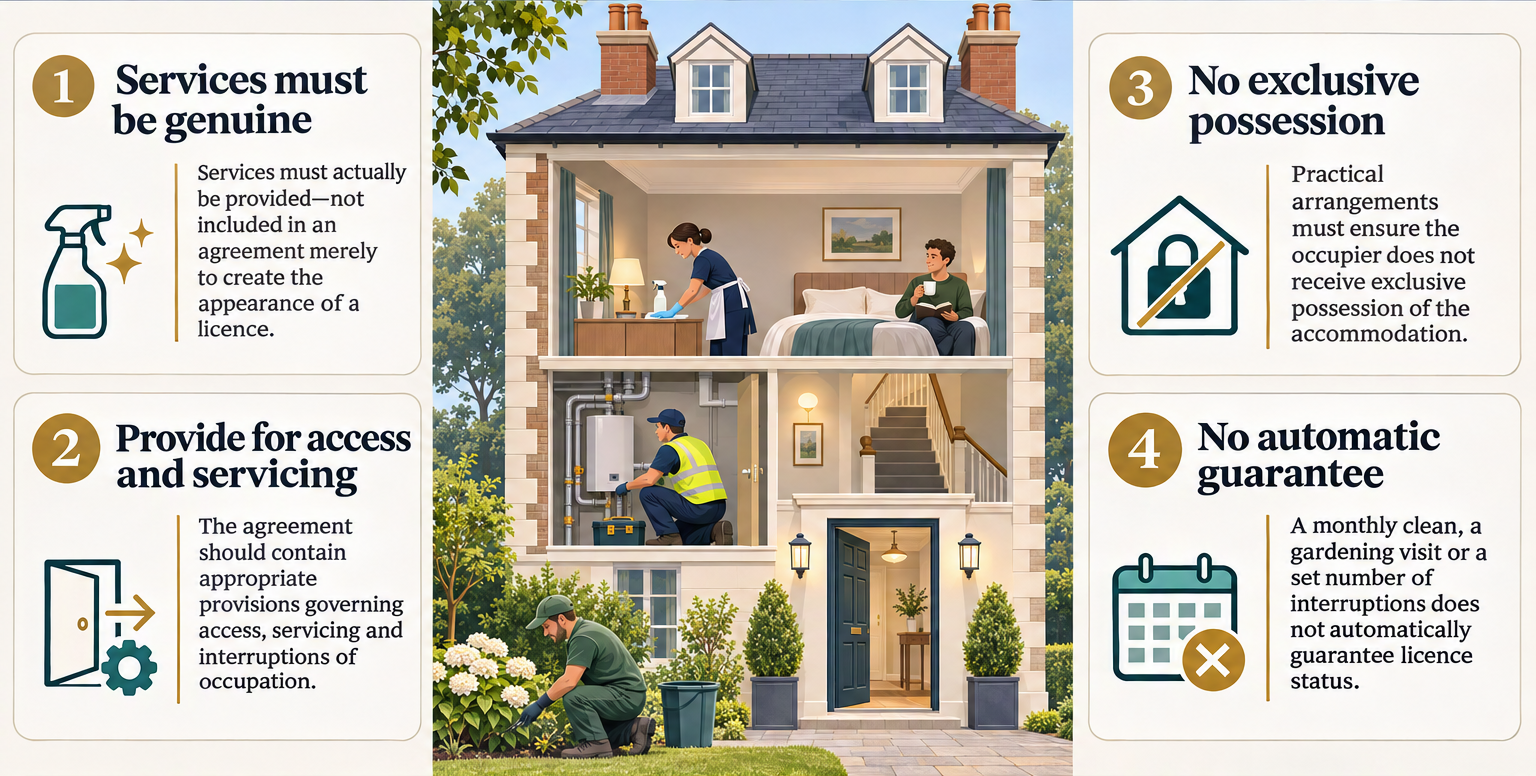
Importantly, these must be genuine services that are actually provided, rather than provisions included in an agreement purely to create the appearance of a licence. The agreement will also contain appropriate provisions governing access, servicing and ‘interruptions’ of the occupation.The practical arrangements must ensure that the occupier does not receive exclusive possession of the accommodation.
There is no automatic rule that a monthly clean, a gardening visit or a particular number of interruptions will guarantee licence status. Each arrangement must be assessed on its individual circumstances and operated accordingly.
What does the licence fee include?
Rather than simply charging a monthly rent, the arrangement is structured around an inclusive licence fee for the serviced accommodation.
The fee can incorporate the following:
- The provision of the accommodation.
- Gas and electricity.
- Water and sewerage.
- Other agreed household services.
- Regular monthly cleaning.
- Gardening and external maintenance.
- Agreed property servicing and management.
The intention is to provide the occupier with a straightforward, inclusive monthly cost, while giving the owner a clearer understanding of the income and expenditure associated with the winter occupation.
Fair usage of utilities
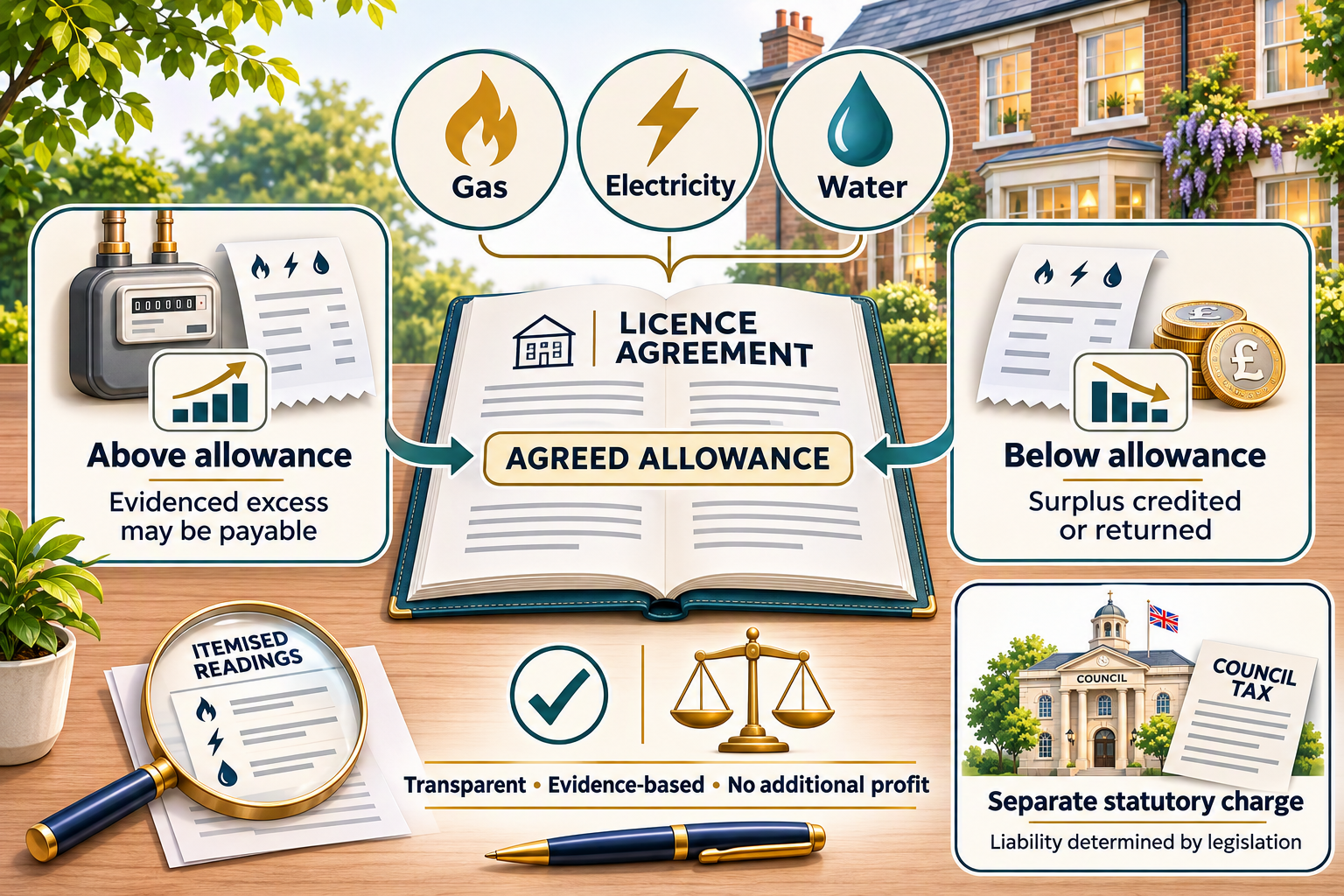
The licence documentation can incorporate a fair-usage approach to consumable utilities. A reasonable allowance is established for the expected consumption of gas, electricity and water.
Where actual consumption exceeds the agreed allowance, the occupier may be responsible for the evidenced excess, in accordance with the agreement. Equally, where actual expenditure is below the allowance, the appropriate surplus is credited or returned.
The methodology should be transparent, supported by reasonable evidence and should not operate as an additional profit-making charge.
Council Tax should be considered separately from consumable utilities because it is a statutory property charge and its liability is determined by legislation.
Council Tax or Business Rates – what applies to your property?
This is an important consideration for Isle of Wight second-home owners.
Since 1 April 2025, Isle of Wight Council has applied a 200% Council Tax charge to qualifying furnished second homes that are not the owner’s sole or main residence. This effectively doubles the standard Council Tax charge. However, certain properties may qualify for different treatment, depending on their use and circumstances.
Council Tax

A property that remains classified as a second home may be subject to the 200% Council Tax premium.
The Council also recognises certain exceptions, including qualifying seasonal homes and properties actively marketed for letting.
The position needs to be considered individually, and owners should not assume that granting a licence automatically removes the second-home premium.
Business Rates

Some commercially operated self-catering holiday accommodation can qualify for Business Rates instead of Council Tax.
In England, the general eligibility criteria include:
- The property must be available commercially for short periods of 28 nights or less.
- It must have been available for at least 140 nights during the preceding 12 months.
- It must actually have been commercially let for at least 70 nights during that period.
- The owner must intend to make it available for at least 140 nights during the following 12 months.
The Valuation Office Agency determines whether a property qualifies. Properties with a rateable value below £15,000 may also qualify for Small Business Rate Relief, subject to the applicable conditions.
An important distinction: a winter Licence to Occupy arrangement lasting several months does not automatically count towards the short-period holiday letting requirements. Owners should not assume that operating a serviced winter licence will make their property eligible for Business Rates.
We recommend that each owner establishes the correct rating and Council Tax position before entering into an arrangement.
What are the benefits to property owners?
For owners with a second home that would otherwise remain vacant during the winter, this approach may offer a number of advantages.
Additional income
Generate income during the quieter months and contribute towards the property’s running costs.
A professionally managed arrangement
The occupier, agreement, servicing programme and property management are dealt with through an established letting and management programme.
A structured alternative to a conventional winter tenancy
The arrangement is designed around genuine, serviced accommodation and a licence rather than an ordinary residential tenancy.
Property oversight
Regular cleaning, inspections, gardening and maintenance help keep the property in good order.
Inclusive pricing
A single monthly licence fee can incorporate accommodation and agreed household services, providing clarity for the occupier and owner.

How BCM Wilson Hill can help
We understand that second homes are important assets and that owners want to protect their properties while making sensible use of them.
Our team can assist with:
- An initial assessment of your property and its suitability.
- Establishing whether the proposed occupation can genuinely operate under a Licence to Occupy.
- Preparing the appropriate licence documentation and occupier application.
- Calculating and agreeing the licence fee and services schedule.
- Finding and qualifying suitable occupiers.
- Arranging cleaning, inspections, gardening and property servicing.
- Managing the occupation and maintaining an appropriate audit trail.
We have developed a dedicated Licence to Occupy documentation pack to support this process, including the occupier application, declaration and operational checklist. Every property and proposed occupation must be assessed individually. Where necessary, we recommend independent legal advice to confirm the suitability of the arrangement.

An opportunity for Isle of Wight second-home owners
The legislative changes do not have to mean that second-home owners must leave their properties vacant throughout the winter. There may still be a worthwhile opportunity to generate income through a properly structured and genuinely serviced short-term accommodation arrangement. The key is getting the documentation, services, management and practical operation right from the outset.
Talk to BCM Wilson Hill
If you own a second home on the Isle of Wight and would like to explore the possibility of winter serviced accommodation, we would be pleased to discuss your property and explain how the arrangement could work for you and your second home.
BCM Wilson Hill
Professional Letting & Property Management
Isle of Wight
Website: www.bcmwilsonhill.co.uk
Email: iowlettings@bcmwilsonhill.co.uk
Telephone: 01983 828800
Important information: This guide is intended as general information and not as legal, tax or rating advice. The legal classification of an occupation depends on the facts and the actual arrangements. A Licence to Occupy does not guarantee exclusion from tenancy legislation. Owners should obtain appropriate legal, tax and rating advice before proceeding.