BCM Wilson Hill strives to exceed client expectations in terms of quality and value in the delivery of our letting and tenancy management services, whilst providing confidence and assurance that our client’s interests are always protected. Our dedicated Lettings Department is 100% committed to the letting of property and the management of tenancies and our staff are trained and highly experienced to advise and guide you through all aspects of letting and tenancy management.
At BCM Wilson Hill we understand that letting your home or investment property can be a daunting prospect and with the introduction of the Renters’ Rights Act 2025 on 1 May 2026, the process of letting a property, setting up and managing a tenancy is now more complex than ever, requiring a comprehensive understanding of this highly intricate legislation.
There are currently over 170 pieces of legislation that relate to the letting of property and the management of tenancies!
It is therefore essential that you minimise your exposure to risk by appointing a professional, ARLA Propertymark accredited letting agent that is up to date with the latest legal changes and operates a robust infrastructure made up of highly skilled and experienced staff with technological resources that assure you receive consistent delivery of top-quality service and ultimate protection.
Letting agents do not currently have to be qualified; anyone can set up a letting agency, but only an ARLA Propertymark agent such as BCM Wilson Hill can provide true protection and peace of mind.
As an ARLA Propertymark agent, BCM Wilson Hill is required to operate with transparency and within a robust Code of Practice, which covers the key stages in letting property and managing tenancies.
There are comprehensive membership Byelaws and benefits which include compliance with issues including:
- Handling and accounting Clients’ money
- ARLA Propertymark Client Money Protection Bonding Scheme
- Mandatory requirement to hold Professional Indemnity Insurance
- Prescribed Complaints and Disciplinary Procedures
Being an ARLA Propertymark Protected Agent Means that BCM Wilson Hill Provide Guarantees
- Your income is backed by ALRA Propertymark Client Money Protection (CMP), a scheme which reimburses landlords and tenants for missing rent or deposits if their agent’s business fails
- That key staff hold property management and lettings qualifications to at least Level 3 (e.g. A Level standard or equivalent)
- That its expertise is continuously enhanced by regular Continuing Professional Development (CPD) and refresher training
- That it belongs to a government approved independent redress scheme: The Property Ombudsman
- Compliance with a nationally recognised Code of Practice
- Protection with appropriate Professional Indemnity Insurance
- That its client accounts are audited annually and verified by ALRA Propertymark compliance
- That it is up to date with the complex legislative changes and best practice
For peace of mind, look for the logo

Protecting Your Interests by Being Compliant
Legislation governing and impacting on the letting of residential property is ever changing and ever increasing. The abundance of laws and regulations are not only complex, but many are subject to causation on others, and all carry punitive consequences in terms of financial penalties and loss of rights and provisions.
Detailed below is a small selection of what are considered key pieces of legislation that if not complied with, carry some of the highest and most impacting punitive consequences.
Renters’ Rights Act 2025 – has introduced major reforms to the private rented sector in England on the 1 May 2026. Here are 10 key points the impact landlords:
- ASTs become periodic tenancies
- New tenancy structure
- Clearer grounds for termination and limits on ‘no-fault’ evictions
- New rules on rent increases
- Restrictions on rent bidding
- Greater rights for tenants to keep pets
- New anti-discrimination measures
- New standards for private rented homes
- New landlord registration and redress requirements
- Expanded local authority powers for enforcement
For a comprehensive guide to the Renters’ Rights Act 2025, please refer to BCM Wilson Hill’s ‘How to Navigate the Renters’ Rights Act 2025′
The Tenant Fees Act 2019 – for all Assured Shorthold Tenancies that began on or after the 1 June 2019, neither a landlord nor agent can require a tenant (or anyone acting on their behalf or guaranteeing their rent) to make certain payments in connection with a tenancy. Nor can a landlord or agent require them to enter into a contract with a third party in connection with a tenancy.
The Act sets out specifically what a tenant may be charged in connection with a Tenancy and deems all other charges that a landlord or agent may make against a tenant, as ‘prohibited payments.’
What fees can a tenant be required to pay?
- The rent
- A refundable tenancy deposit capped at no more than five weeks’ rent where the annual rent is less than £50,000; or six weeks’ rent where the total annual rent is £50,000 or above. This applies to existing tenancies that are renewed on or after 1 June 2019 – meaning that there is a requirement to refund any sum of an existing tenancy deposit held that exceeds the cap
- A refundable holding deposit (to reserve a property) capped at no more than
- one week’s rent
- Payments to vary the terms of a tenancy when requested by the tenant, capped at £50, or reasonable costs incurred if higher
- Payments associated with early termination of the tenancy, when requested by the tenant.
- Payments in respect of utilities, communication services, TV licence and council tax; and
If a tenant has been charged a ‘prohibited payment’ or the tenant’s holding deposit has been unlawfully retained, the landlord cannot use the Section 8 eviction procedure until the prohibited payment and or any unlawfully retained holding deposit has been repaid.
The Deregulation Act 2015 – requires the preparation of and service on the tenant of prescribed valid documents that entitle the landlord to use the Section 8 provision of the Housing Act 1988 to regain possession of their property.
BCM Wilson Hill will prepare and serve on the tenant the requisite documentation that entitles you to the provision of Section 8 of the Housing Act 1988, allowing you to regain possession of your property.
The Energy Efficiency Regulations 2015 & Minimum Energy Efficiency Standards (MEES) – it is unlawful for a landlord to grant a new tenancy or renew an existing tenancy on a property that has an energy efficiency rating of F and G.
The Energy Efficiency Regulations 2015 & Minimum Energy Efficiency Standards (MEES) – it is unlawful for a landlord to grant a new tenancy or renew an existing tenancy on a property that has an energy efficiency rating of F and G.
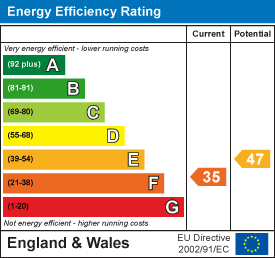
From the 1 October 2015 legislation requires that all tenants must be issued with a copy of the property’s EPC together with other prescribed documents.
The EPC is valid for 10 years and from 1 April 2018 the rating of an EPC for all property to be let, including the renewing of existing tenancies, must be at least an E.
If the EPC rating of your property is F or G, BCM Wilson Hill offers an EPC ‘remodelling’ service under which the improvements required to increase the rating to the minimum E rating can be determined.
BCM Wilson Hill will check the national register to establish if your property has an EPC and if so, will check its rating.
However, on the 21 January 2026, the UK government announced what it has called its ‘Warm Homes Plan’, which is an update to the Minimum Energy Efficiency Standards (MEES).
Private landlords in England and Wales will need to make sure their properties achieve an EPC rating of C or above by 1 October 2030, for all tenancies, unless they have an exemption.
The measures outlined are aimed at reducing energy bills and accelerating home improvements via a combination of updated standards, investment and financing.
The consultation on the metrics for the new EPC regime, titled Home Energy Model (HEM) closed on 18 March 2026. The HEM will replace the current Energy Efficiency Rating (EER) methodology and will be launched in the second half of 2027 and will be compulsory for new EPCs from 1 October 2029.
The key headlines of the announcement are:
- EPCs will have four clear metrics: energy cost, fabric performance, heating systems, and smart readiness.
- A property can meet the compliance requirements using either a heat or smart metric.
- The 10-year validity period will remain.
- A low value exemption will apply if £10,000 exceeds 10% of the property’s value.
- Money spent on energy efficiency improvements since October 2025 will count towards the cost cap.
- Properties achieving an EPC of C before 1 October 2029 will be deemed compliant until the certificate expires.
- There are grants available for hydraulic and heat pumps, as well as biomass boilers for eligible rural properties.
- Currently, short term lets are outside of the policy, but the government will consult on this.
The Immigration Act 2014 & Right to Rent – Right to Rent checks must be carried out on all prospective adult occupiers with follow up checks carried out where tenants satisfied initial checks using time limited ID. Where Right to Rent is time limited, the responsible landlord or agent needs to carry out follow up checks in accordance with the Immigration Act 2014, and where appropriate, notify the Home Office that the time-limited Right to Rent has expired.
The Gas Safety Regulations 1998 – landlords must arrange for a Gas Safe accredited engineer to carry out an annual gas safety check on every gas appliance and flue in a property that is let and issue the tenant with a valid report within the prescribed time limits.

The Electrical Safety Standards in the Private Rented Sector (England) Regulations 2020 – apply in England to all new tenancies (a renewed tenancy is deemed a new tenancy) that start on or after the 1 July 2020 and all existing specified tenancies must comply from 1 April 2021. Landlords must ensure every electrical installation in their residential premises are inspected and tested at intervals of no more than 5 years by a qualified and competent person.
The Smoke and Carbon Monoxide Alarm Regulations 2015 – landlords are required to ensure that a smoke alarm is fitted on every floor of their property where there is a room used wholly or partly as living accommodation. They are also required to ensure that a carbon monoxide alarm is fitted in any room where gas and/or solid fuel is burnt.
The Housing Act 2004 (tenancy deposit protection) – requires the protection of a tenant’s deposit with one of the three government approved schemes and for documentation to be served on the tenant within a prescribed time limit.
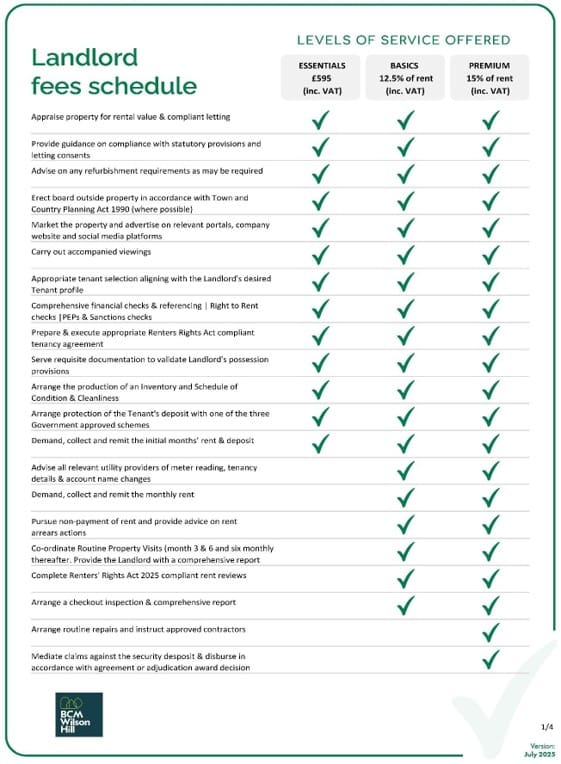
Under our ‘BASICS & ‘PREMIUM’ tenancy management services, BCM Wilson Hill will manage the protection of the tenant’s deposit under its membership to Tenancy Deposit Scheme (TDS), in the interests of compliance with the requirements of the Housing Act 2004.
For clients who opt for the ‘ESSENTIALS’ let-only service, the responsibility for protecting and administering any tenancy deposit that they may require a tenant to pay is theirs.
Non-compliance with the requirements to protect a tenant’s deposit carries considerable penalties:
- Loss of provision to recover possession of the property under Section 8 of the Housing Act 1988
- A fine payable to the tenant of up to three times the sum of the deposit
- The return of the deposit to the tenant
Membership to a tenancy deposit scheme also entitles landlords and tenants whose tenancies commenced on or after the 6 April 2007 to a free dispute resolution service in the event of a dispute over the disbursement of the deposit at the end of the tenancy.
Dispute resolution services only use documentary and photographic evidence to make awards and whilst an inventory check-in inspection with a tenant at the start of a tenancy benefits the interest of both the tenant and the landlord, the burden of proof falls on the landlord to demonstrate that any claims for damages against a tenant’s tenancy deposit at the end of the tenancy are justified and can be substantiated by documentary and photographic evidence.
It is best practice and the evidence is considered more favourably by dispute resolution adjudicators when inventory check-ins and check-outs have been conducted by an independent, professionally qualified person (e.g. a specialist inventory clerk).
What is an Inventory & Schedule of Condition & Cleanliness?
It is a document produced just prior to the commencement of a tenancy which details the cleanliness of the property together with the condition of any contents, including fixtures, fittings at the property, both internally and externally.
At the end of a tenancy and following the tenant’s vacation from the property, the agreed inventory and schedule of condition & cleanliness is used to reconcile the condition of the property at Check-out against that agreed at Check-in.
BCM Wilson Hill appoints experienced and professionally qualified inventory clerks to produce inventories and schedule of conditions & cleanliness, to undertake the Check-in and Checkout inspections and to report in detail the findings of the Check-out.
With free, evidence-based dispute resolution available, considering the relatively low cost of an inventory & schedule of condition & cleanliness against the potentially high financial loss in the event of an unsuccessful claim against a tenant’s deposit, can you afford not to have one?
The Inventory Check-in
The Tenant Fees Act 2019 prohibits a tenant from being charged for an inventory check-in inspection.
Under our ‘BASICS’ & ‘PREMIUM’ tenancy management services, you have the option of a ‘1-1 Tenant Check-in with an independent inventory clerk’. You will find this service listed in the ‘Additional Services & Fees’, of our Terms of Business.
The ‘1-1 Tenant Check-in with an independent inventory clerk’ costs just £115.00 including VAT and will ensure that you are afforded a controlled and impartial agreement of this vital document.
In the event that this option is not chosen, the tenant will be given a copy of the inventory and schedule of condition & cleanliness for your property and asked to check and make any comments on it that they feel appropriate that relate to the condition and cleanliness of the property and or its fixtures, fittings and any contents. However, they will do so without the supervision or control of an impartial party and once the inventory and schedule of condition & cleanliness is signed it will be used as such for the Check-out inspection at the end of tenancy and will form a crucial part of any evidence that you may need to rely on in the event of a dispute over any damage, cleaning or missing items.
Guarantee Your Rent and Protect Against Legal Expenses
As conscientious letting agents we want to ensure that you receive a rental payment each month, even if your tenant defaults.
We have partnered with a specialist tenant referencing agency to ensure that all tenants are comprehensively screened and, as a result, we are confident that you will have a great tenant from the outset. This is not to say that a person’s circumstances may change through no fault of their own, i.e., redundancy or poor health and these situations can sometimes leave tenants unable to keep up with rental payments.
Our market leading Rent Guarantee & Legal Expenses Protection will not only ensure that you always get your rent but will also cover the legal costs up to a combined total of £100,000 of any claim.
We strongly recommend that you consider the relatively low cost against what could be a considerable sum in rent at risk of loss and legal fees incurred, in the event of default on rental payments and eviction costs.
The policy is for a 12-month term and covers the property and not the tenant, so if the tenant vacates after say 6 months and a new tenant moves in, you will not need to purchase a new guarantee for the remaining 6 months. The new incoming tenant would have to be supported with a qualifying referencing ‘Pass’ award, which would be secured via the referencing and screening process.
Rent Guarantee & Legal Protection – What will you be Covered for?
- 100% of the monthly rent (capped at £8,000pcm)
- Nil excess policy
- All legal costs associated with eviction (mediation, serving of notices, bailiffs, locksmiths, court costs etc.) are covered, up to £100,000 per claim and includes £1,000 of property damage remedial works
- The policy will pay rent for an indefinite period until vacant possession
- There is no limit to the number of months of missed rent that the policy will pay out, except where the tenant provides a valid defense to the eviction, in which case the payments are capped at 12 months.
- If the property has been damaged, the policy will pay a sum equal to;
- 100% of the monthly rent for month 1 after vacant possession has been obtained,
- 75% for month 2 and;
- 50% for month 3, to provide for the time required to restore the property to re-lettable state
- There is no ‘no claims period’ meaning that cover can be added to any existing tenancy and claim straight away
Choose the Level of Service That’s Best for You
The range of letting and tenancy management services offered have been carefully designed to provide you with choice, flexibility, peace of mind and great value for money.
You can even enhance your service level choice with a menu driven selection of ‘Addition Services & Products’ and opting for these is as easy as checking the appropriate box on the Terms of Business.